Picture this. It is a Thursday night, 8 p.m. and you are at your son’s third varsity baseball game of the week. As the boys are lining up to shake hands, you see one of your son’s friends keeping his head down, walking slower than usual and refusing to make eye contact with the opposing team. You don’t know him that well. Sure, he’s grown up playing baseball with your kid. You know his name, his position and maybe how well he played that day. Maybe you recognize that on this particular day, he didn’t play well, and that explains his devastated posture.
But what you may fail to realize is that this is his seventh bad game of the season. Even though it may not be apparent to you, he knows he has been failing consistently this season. And what you definitely aren’t aware of are the 15 texts he will receive from different coaches the following day, telling him what he has been doing wrong. On top of that, he has 2 hours of homework to complete when he gets home, and two tests to take the following day. Tomorrow afternoon, he has yet another baseball game to attend that he does not feel prepared for.
And, potentially the worst part of it all, tomorrow he will be expected to show up to school and baseball with a smile on his face, tackling it all with courage and bravery.
Well, guess what. He is a child, and he shouldn’t have to.
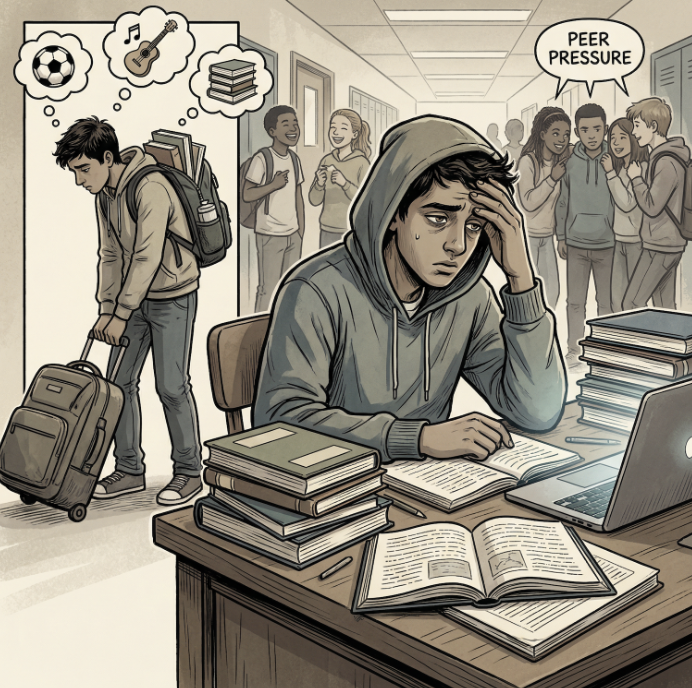
Student athletes all around the world, no matter what sport they play, are under rigorous training and game schedules, on top of the constant attention that school requires. Most student-athletes practice or compete nearly every day while balancing demanding academic schedules, creating overwhelming pressure that often goes unnoticed. They deserve to be given the resources, especially in the mental health department, that they need to succeed and persevere.
As technology has advanced, social media has created a platform for sports where every mistake is viewable. Evaluation is constant and creates a deep feeling of pressure among young kids whose brains are still developing. With the constant pressure comes an increasing number of students who begin to tie their identity to their sport. Every loss comes back to a mistake they made, and every mistake they made was a reflection of their character.
As a 15-year-old girl who has played softball for eight years, I have had countless experiences of stress, extreme sadness, and self-doubt all tied to my sport and leading to burnout in my social and academic life. Just this year, I struggled in the first half of my softball season to produce results in the way my coaches were expecting me to. Eventually, the softball schedule felt like too much, and I dreaded going to school each day. I ran on little sleep, put minimal effort into assignments, and could feel myself becoming mentally checked out while playing the sport I supposedly loved.
Throughout this experience, I had to look through the criticism and insults to the few people and messages that were purely there to support me. Knowing that at least one person believed in me allowed me to find the smallest bit of willpower to get up each day.
What I realized from that experience is that every student-athlete deserves to have that person.
Don’t just take my word for it. Look at the numbers. According to the NFHS, the national authority for high school athletics and performing arts in the U.S., “…a staggering 91 percent of high school student-athletes report experiencing some level of stress associated with balancing sports and academics. Only 10 percent of student-athletes seek professional mental health care.”
If so many student-athletes are struggling mentally with the task of balancing sports, life, sleep, and social activity, why aren’t they given the resources they need to succeed? If school sports are going to create the demanding schedules they do for young athletes, they absolutely need to supply mental health resources to the students who need them.
Some adults may argue that teens are just being dramatic or lazy. After all, aren’t sports supposed to be fun games?
But when a child with a high passion for their sport mixes with perfectionism, parental pressure, stress, and even coaching challenges, that child is much more vulnerable to burnout. Burnout is just as common in teens as in adults. According to News at Indiana University, “We found that 27% of teens are actively struggling with burnout, and many are not regularly engaging in self-care practices- enough sleep, exercise, time outdoors, having fun or relaxing- to help them deal with the pressures they face.”
So, now that we have the facts, it is clear that solutions and resources must be implemented in high schools immediately.
This can look like providing access to a counselor who specializes in sports psychology (who is accessible during the school day), providing programs to educate students on stress management, having counselors check in on student-athletes often and provide more tutoring options if needed, and having teachers be slightly more flexible with deadlines at certain times if a student really needs extra support.
All student-athletes are destined to fail and struggle at some point in their high school career. This only goes to show how important it is that they get the support and love they need to keep showing up each day. Providing more support for our youth builds a stronger, resilient, and hopeful next generation of future adults.
Next time you look out onto the baseball field or basketball court, take notice of that one kid who may be silently struggling. Instead of brushing it off, talk to someone at the school who may be able to implement more resources and support into the school community. Be the person to make a change, and if you can’t be that, at least be the person who will always show constant support.